0x04.进程权限管理
前面我们讲到,kernel 调度着一切的系统资源,并为用户应用程式提供运行环境,相应地,应用程式的权限也都是由 kernel 进行管理的
一、进程描述符(process descriptor)
在内核中使用结构体 task_struct 表示一个进程,该结构体定义于内核源码include/linux/sched.h中,代码比较长就不在这里贴出了
一个进程描述符的结构应当如下图所示:
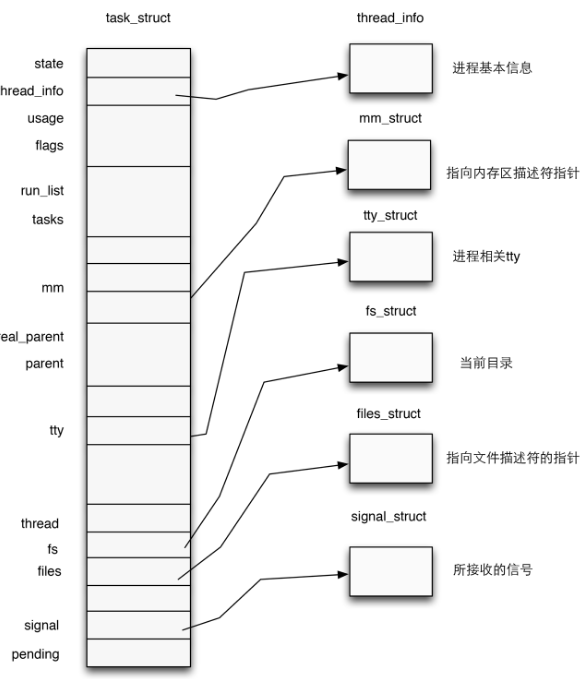
本篇我们主要关心其对于进程权限的管理
注意到task_struct的源码中有如下代码:
    /* Process credentials: */

    /* Tracer's credentials at attach: */
    const struct cred __rcu        *ptracer_cred;

    /* Objective and real subjective task credentials (COW): */
    const struct cred __rcu        *real_cred;

    /* Effective (overridable) subjective task credentials (COW): */
    const struct cred __rcu        *cred;
Process credentials 是 kernel 用以判断一个进程权限的凭证,在 kernel 中使用 cred 结构体进行标识,对于一个进程而言应当有三个 cred:
- ptracer_cred:使用
ptrace系统调用跟踪该进程的上级进程的cred(gdb调试便是使用了这个系统调用,常见的反调试机制的原理便是提前占用了这个位置) - real_cred:即客体凭证(objective cred),通常是一个进程最初启动时所具有的权限
- cred:即主体凭证(subjective cred),该进程的有效cred,kernel以此作为进程权限的凭证
一般情况下,主体凭证与客体凭证的值是相同的
例:当进程 A 向进程 B 发送消息时,A为主体,B为客体
进程权限凭证:cred结构体
对于一个进程,在内核当中使用一个结构体cred管理其权限,该结构体定义于内核源码include/linux/cred.h中,如下:
struct cred {
    atomic_t    usage;
#ifdef CONFIG_DEBUG_CREDENTIALS
    atomic_t    subscribers;    /* number of processes subscribed */
    void        *put_addr;
    unsigned    magic;
#define CRED_MAGIC    0x43736564
#define CRED_MAGIC_DEAD    0x44656144
#endif
    kuid_t        uid;        /* real UID of the task */
    kgid_t        gid;        /* real GID of the task */
    kuid_t        suid;        /* saved UID of the task */
    kgid_t        sgid;        /* saved GID of the task */
    kuid_t        euid;        /* effective UID of the task */
    kgid_t        egid;        /* effective GID of the task */
    kuid_t        fsuid;        /* UID for VFS ops */
    kgid_t        fsgid;        /* GID for VFS ops */
    unsigned    securebits;    /* SUID-less security management */
    kernel_cap_t    cap_inheritable; /* caps our children can inherit */
    kernel_cap_t    cap_permitted;    /* caps we're permitted */
    kernel_cap_t    cap_effective;    /* caps we can actually use */
    kernel_cap_t    cap_bset;    /* capability bounding set */
    kernel_cap_t    cap_ambient;    /* Ambient capability set */
#ifdef CONFIG_KEYS
    unsigned char    jit_keyring;    /* default keyring to attach requested
                     * keys to */
    struct key    *session_keyring; /* keyring inherited over fork */
    struct key    *process_keyring; /* keyring private to this process */
    struct key    *thread_keyring; /* keyring private to this thread */
    struct key    *request_key_auth; /* assumed request_key authority */
#endif
#ifdef CONFIG_SECURITY
    void        *security;    /* subjective LSM security */
#endif
    struct user_struct *user;    /* real user ID subscription */
    struct user_namespace *user_ns; /* user_ns the caps and keyrings are relative to. */
    struct group_info *group_info;    /* supplementary groups for euid/fsgid */
    /* RCU deletion */
    union {
        int non_rcu;            /* Can we skip RCU deletion? */
        struct rcu_head    rcu;        /* RCU deletion hook */
    };
} __randomize_layout;
我们主要关注cred结构体中管理权限的变量
用户ID & 组ID
一个cred结构体中记载了一个进程四种不同的用户ID:
- 真实用户ID(real UID):标识一个进程启动时的用户ID
- 保存用户ID(saved UID):标识一个进程最初的有效用户ID
- 有效用户ID(effective UID):标识一个进程正在运行时所属的用户ID,一个进程在运行途中是可以改变自己所属用户的,因而权限机制也是通过有效用户ID进行认证的,内核通过 euid 来进行特权判断;为了防止用户一直使用高权限,当任务完成之后,euid 会与 suid 进行交换,恢复进程的有效权限
- 文件系统用户ID(UID for VFS ops):标识一个进程创建文件时进行标识的用户ID
在通常情况下这几个ID应当都是相同的
用户组ID同样分为四个:真实组ID、保存组ID、有效组ID、文件系统组ID,与用户ID是类似的,这里便不再赘叙
二、进程权限改变
前面我们讲到,一个进程的权限是由位于内核空间的 cred 结构体进行管理的,那么我们不难想到:只要改变一个进程的 cred 结构体,就能改变其执行权限
在内核空间有如下两个函数,都位于 kernel/cred.c 中:
struct cred* prepare_kernel_cred(struct task_struct* daemon):该函数用以拷贝一个进程的cred结构体,并返回一个新的cred结构体,需要注意的是daemon参数应为有效的进程描述符地址int commit_creds(struct cred *new):该函数用以将一个新的cred结构体应用到进程